AI visibility: crawled is not cited, or paid
AI visibility is whether AI systems read a site, cite it in their answers, and send people to it. On wiserstaff.com, Microsoft Copilot logged 6,809 citations between 16 August and 3 October 2026, while affiliate commissions stayed at $0. Crawled, cited and paid are three separate readings, and on wiserstaff.com they did not move together.
On 5 October 2026, six of Google’s first nine US results for “AI visibility” were vendor pages, tools or a list of tools for measuring it. We measured the chain behind that number on wiserstaff.com, my own blog of HR-software reviews, published under a pen name: 6,809 citations by Microsoft Copilot between 16 August and 3 October 2026, and $0 of affiliate commission by 4 October. Being fetched by an AI crawler, being cited in an AI answer and being paid are three different readings. This page publishes all three, dated, from the sites we manage, with the dated rows on our figures page.
What AI visibility means
AI visibility is whether AI systems read a site, cite it in their answers, and send people to it. Each part has its own instrument: bot logs count the crawling, an engine’s own report the citations, analytics the visits. A score that blends them hides which part moved, and on wiserstaff.com the three did not move together.
The guides among those results define the term. Neither of the two we could read publishes the chain on a real site, from the crawler to the bank account. That chain is what our AI Citation Meter is built to measure, and we keep it in three columns and never add them.
Crawled, cited, paid is the reading we use:
- Crawled: a request that a bot panel files under AI activity, mostly from bots run by AI companies. Counted in requests, per operator.
- Cited: a named engine put the site among the sources of an answer. Counted per engine, never summed across engines.
- Paid: money or an order arrived that can be traced to that engine. Counted in dollars or orders, nothing else.
Visits sit between the last two: we measure them too, and a visit is not money either. A figure in one column does not establish the next one. The rest of this page shows why.
One week, every layer
In the week of 25 to 31 August 2026, wiserstaff.com received 744 requests from AI bots and 2,439 citations from Microsoft Copilot. Under 1% of its sessions came from an AI assistant, and affiliate commissions were zero. Each reading comes from our own account on the service, for those seven days, unless the table says otherwise.
| Layer | Reading, 25 to 31 August 2026 | Instrument |
|---|---|---|
| Crawled | 744 requests from AI bots: OpenAI 178, Huawei 128, Anthropic 102, Google 82, Microsoft 68, Amazon 56, Perplexity 35, others 95 | Microsoft Clarity, bot activity |
| Cited by Copilot | 2,439 citations | Bing Webmaster Tools, daily AI citation series (Clarity reads the same Microsoft data, with a lag) |
| Cited by other engines | 0 for each engine checked: ChatGPT, Google AI Overviews, Perplexity | our own checks outside Microsoft’s reports, run on 28 August (ChatGPT) and 31 August (Google, Perplexity) |
| Visited | under 1% of sessions from an AI assistant | Microsoft Clarity (it shows the share, not the count) |
| Paid | $0 affiliate commission; 0 customers, 0 transactions, cumulative to 4 October | the affiliate network’s partner reporting |
Microsoft’s bots sent fewer requests than OpenAI’s, Huawei’s, Anthropic’s or Google’s, and Microsoft’s Copilot is the only engine that cited the site. OpenAI’s bots sent the most; no ChatGPT citation turned up in our checks that week, and all AI assistants together sent under 1% of sessions. Half of that week’s bot requests did not ask for an article at all: in the week to 3 September, 383 of 762 bot requests went to the home page, robots.txt or the sitemap.
Crawled: who reads the site
AI crawling is the requests a site receives from bots that a panel classes as AI activity. On wiserstaff.com it ran between 744 and 1,090 a week in four seven-day readings, the first two overlapping: 15% to 20% of all requests on the panel. OpenAI led three weeks, Anthropic one, and the volume did not track the citations.
| Week ending | AI bot requests | Busiest operator | Microsoft |
|---|---|---|---|
| 31 August | 744 | OpenAI 178 | 68 |
| 3 September | 762 | OpenAI 181 | 60 |
| 10 September | 1,090 | OpenAI 245 | 76 |
| 22 September | 986 | Anthropic 175 | 146 |
The page Copilot cited most, our Deel review, received 6 AI bot requests in the week to 31 August. From 16 to 29 August, it collected 2,011 citations, the most of any page. A citation does not need a fresh visit from the crawler, so request counts are a poor proxy for anything that follows. The two busiest weeks in the table, to 10 and 22 September, both fall inside the Copilot pause described below, with no citation at all.
Two cautions on reading this column. The bot panel we use also files secret-scanning requests under AI activity, and the weekly totals above include them as reported. In a fifth reading, the week to 22 August, 51 of 856 requests were scans for files such as /.git/config or /secrets.json, all 51 answered with a 404. And ChatGPT-User, which made 21 requests to the site in the 24 hours to 5 October, is not an indexing crawler: it fetches a page while a ChatGPT user is in a conversation. Its requests show a page being fetched, which is a different event from being cited.
Cited: which engine names the site
AI citation means a named engine lists the site among the sources of an answer. For wiserstaff.com, that engine was Microsoft Copilot, almost alone: 6,809 citations from 16 August to 3 October 2026, read from Bing Webmaster Tools, which calls its figures a sample. Other engines stayed at zero in our August checks; the first non-Microsoft citations came in October.
Three facts about the Copilot series matter more than its total:
- In the first five-day reading, from 16 to 20 August, 97% of the citations came from vendor-brand queries (Deel, Breezy, Gusto), and all of them came from 6 of the 35 pages then published. The review pages were cited; the 21 best-of lists then online collected 3 citations between them in the two weeks to 29 August. Over the full series, four review pages drew 5,693 of the 6,809 citations, the pricing guide 322, and 11 of the 24 best-of lists online by October 401 between them, mostly after the pause; the fifth review received none.
- It fell to near zero twice: 0, 3, 0 and 0 from 21 to 24 August, then 0 every day from 1 to 23 September. On 7 September, inside the second pause, Bing’s crawler made 15 successful requests in a day,
robots.txtwas unchanged and no AI crawler was blocked. Citations came back on 24 September and passed their August daily peak of 415, with 582 on 2 October. The cause of the pause was not established. - Bing’s search index and Copilot’s citations are separate: on 22 August, Bing’s index held 9 URLs of the site and not one review or guide, while Copilot had cited the Deel review 552 times from 16 to 20 August. Yet both stopped in early September: Bing search showed the site again from 23 September and Copilot cited it again from 24 September. Separate counters, not necessarily separate causes.
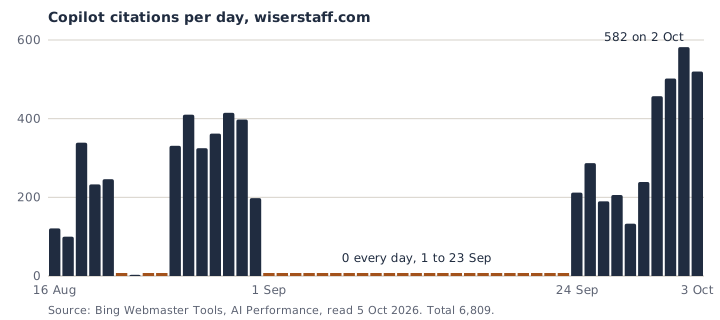
Daily Copilot citations of wiserstaff.com, as Bing Webmaster Tools reported them on 5 October 2026. The amber marks are days at zero.
The other engines, each counted on its own:
| Engine | Reading | When |
|---|---|---|
| Perplexity | 0 citations on five check dates, 6 questions each (one answer came back empty on 16 August, leaving 5 readable); 0 again on 31 August, in 5 readable answers | 2, 8, 11, 16, 22 and 31 August 2026 |
| Google AI Overviews | 0 citations in the same 6 questions, on the same five dates; 0 again on 31 August, in 5 readable answers | 2, 8, 11, 16, 22 and 31 August 2026 |
| ChatGPT and Google AI Overviews, a paid SEO data service’s database of AI answers | 0 citations from October 2025 to September 2026 (the site went live in June 2026); 1 Google AI Overview citation appears in October 2026, on our HR-software pricing guide | read on 5 October 2026 |
| ChatGPT search, fixed set of 10 questions | 0 of 10 on 28 August; 1 of 10 on 4 October, plus 2 answers that retrieved the site without citing it; each answer read once | 28 August and 4 October 2026 |
One answer out of ten, read once, is a first sighting. We publish it as one and will call it a trend only after repeated readings. Corrected on 9 October 2026: this row first said 3 of 10, counting two answers that only retrieved the site among their search results.
Visited: what the citations send
AI referral traffic is the visits that arrive from an AI assistant’s answer. On wiserstaff.com it stayed near zero while the citations climbed: under 1% of sessions in the week of 2,439 Copilot citations, then 0 assistant visits in Cloudflare’s web analytics in the week to 4 October. On wiserstaff.com, a citation showed the site and rarely sent anyone.
The opposite case exists on another site we manage. riin-art.com is a shop I built for a client, whose figures I publish with the client’s agreement. There, ChatGPT sent 42 sessions in the 30 days to 22 September 2026, which made it the site’s third channel, after direct visits and organic search. Those sessions carried 4 of the site’s 6 tracked key events: three clicks to its WhatsApp contact and one enquiry form. Between 8 and 20 September, Copilot cited riin-art.com 50 times, and the shop’s analytics recorded no visit from Copilot in the twelve months to 23 September.
On wiserstaff.com, the engine that cited most sent almost no one. On riin-art.com, Copilot cited the site 50 times without a recorded visit, and the visitors came from ChatGPT, whose citations of that site we have not counted.
Paid: what came in
Copilot’s citations turned into $0 of affiliate commission on wiserstaff.com by 4 October 2026: 0 customers and 0 transactions, against thousands of citations. On riin-art.com, ChatGPT’s visitors reached a WhatsApp chat, and a click to a chat is not an order. No sale on wiserstaff.com traces back to an AI engine; riin-art.com does not record orders at all.
Two details keep this column honest:
- The only money wiserstaff.com has earned is a one-off $100 reward from a software vendor, and it is not from AI visibility. It was paid in September 2026, on publication of an article entered in that vendor’s content challenge, and the article discloses it. It arrived through the same partner account as the commissions, but it is not a commission and is not counted as one.
- The shop’s analytics records clicks and enquiries, not orders. Whatever happened in the chat afterwards is outside the site, and outside this table.
Counting a citation as revenue, or a click as an order, is how a visibility score becomes a business case it has not earned. Which page features went with being cited at all is a separate test, in the LLM SEO levers we scored.
Is Google visibility the same as AI visibility?
No. On wiserstaff.com, Google search and Copilot did not move together. In late August 2026, Google Search Console put the site at an average position of 64.5 while Copilot cited it thousands of times. Bing search, a third surface, showed no impression of the site from 31 August to 22 September. Each surface needs its own reading.
In these readings, we found no stable pattern that lets one surface stand in for another. Copilot cited pages that Bing’s index did not list. Google’s AI Overviews cited the site in none of our checks, nor in the data service’s database, until October, while Google indexed 53 of the site’s 54 URLs, as read on 23 September. A single “AI visibility” figure that is really a Google ranking, or a Bing ranking, measures the wrong thing.
How to read an AI visibility score
An AI visibility score is only as good as the engine it names and the window it covers. Before trusting one, check five things: whether two panels count the same data, how the share is calculated, whether bot counts include scanners, whether small numbers are quoted as rates, and whether the export covers the whole window, after reporting lag.
Each of the five, with the dated reading where we met it:
- Two panels, one data source. For the five days from 16 to 20 August 2026, Bing Webmaster Tools and Microsoft Clarity both reported 1,039 Copilot citations. They read the same Microsoft data; adding them would double the figure.
- A share that excludes the bad days. Clarity reports our share of all citations on the queries where the site appeared, and it leaves out the days on which the site was not cited, so it reads high by construction. Our 23.7% in the export of 31 August (1,843 of 7,775 citations on those queries, the same truncated export as in item 5) is best read as a ceiling.
- Bot counts that include scanners: the 51 scans of the week to 22 August, described above.
- Small numbers quoted as rates. On wiserstaff.com, in the week to 10 September, three AI sessions out of 44 made 6.8%, and it is still three sessions. Below twenty, we quote counts.
- An export read before the last days arrived. Clarity’s export of 31 August showed 1,843 Copilot citations for the week. Bing’s daily series, read a week later, gives 1,843 for 25 to 29 August and 2,439 for the full seven days: the last two days had not arrived yet.
If you run a single site and read your own consoles, the free reports above answer most of these questions for Copilot; other engines need separate checks, and you may not need the product this page links to.
What we do with these readings
We judge what AI visibility is worth by its last column, not its first. Crawls and citations go in the log, each citation with its engine named; only a traced sale shows that a page earned money. On wiserstaff.com, thousands of Copilot citations have not yet earned a cent of commission, and the readings stay published with their zeros.
- Observation: on wiserstaff.com in August, the operator that crawled most did not cite the site, and the engine that cited it sent almost no one; on riin-art.com, ChatGPT sent visitors. No sale has been traced to an AI engine on either site.
- Conclusion: crawled, cited and paid are separate measurements, and a score that merges them without showing each column cannot tell you which one moved.
- Recommendation: name the engine in every sentence about AI visibility, keep the three columns apart, and give a citation no money value until a sale is traced to it.
The next reading of these series is due with our monthly review. The rows that are already public sit on our figures page; what we stopped measuring and why is in our account of which SEO tasks we automate.
Questions
What is AI visibility?
AI visibility is whether AI systems read a site, cite it in their answers, and send people to it. Each is measured by a different instrument, so a single score blends them. On wiserstaff.com, the three did not move together: heavy citation by one engine came with almost no visits and no commission.
Is Google visibility the same as AI visibility?
No. On 22 August 2026, Bing's index held 9 URLs of wiserstaff.com and not one review or guide, yet Copilot had cited the site's Deel review 552 times in five days. In late August, Google ranked the site at an average position of 64.5, and its AI Overviews cited none of its pages until one citation appeared in October.
How can I check my AI visibility?
Start with the engine, not the score. Bing Webmaster Tools reports Copilot citations for a verified site, free; your analytics shows visits from AI assistants; your server or CDN logs show which AI bots requested pages. Those three answer different questions, for Copilot only; other engines need separate checks. A score that does not disclose its engines cannot answer them precisely.
How do you get cited by ChatGPT?
We cannot tell you; our readings do not show a method. Our blog was absent from ChatGPT's cited sources in our August checks, until a fixed set of ten questions on 4 October 2026, where one answer cited it and two more listed it among the pages searched without citing it, each answer read once. ChatGPT's user fetcher requested its pages 21 times in one day, which is fetching, not citing.